Q6
Question
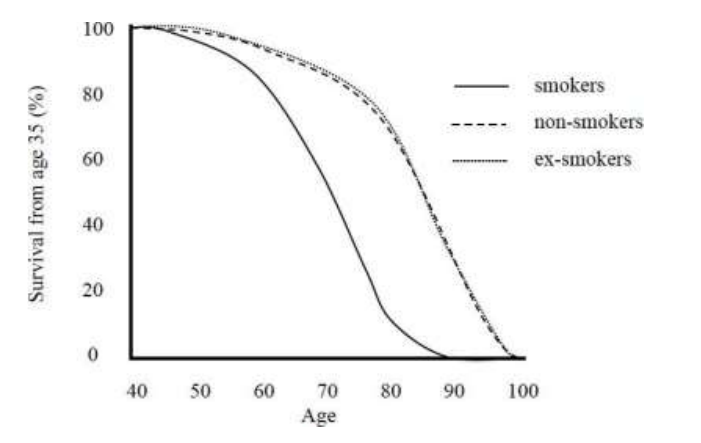
Questions 5 - 7 refer to the information below about the British Doctors’ Study. The British Doctors’ Study was an epidemiological cohort study which started in 1951 and ran until 2001. It set out to establish whether, as strongly suspected, there was a link between smoking and health outcomes. It was the first study to prove the link between smoking and lung cancer and was hugely influential in informing government moves to reduce smoking. A very large number of male doctors were sent health surveys at regular intervals. These asked questions about any health issues they might have as well as about lifestyle factors such as alcohol consumption, diet and smoking habits. The simplified graph below illustrates one of their findings.
Which one of the following statements about giving up smoking is best supported by this graph?
(A) If you give up smoking early enough, you have virtually the same life expectancy as a non-smoker.
(B) More people give up smoking before the age of 40 than do afterwards.
(C) It is smoking early in life which causes most of the damage to health.
(D) Giving up smoking gives you a better life expectancy than a smoker, but not as good as someone who has never smoked
Syllabus alignment
- EpidemiologyAnalyse incidence and prevalence patterns of non-infectious diseases in populations.
- EpidemiologyEvaluate the method used in an epidemiological study.