Q28 (b)
Question
Huntington’s disease is an autosomal dominant condition caused by a mutation of a gene on chromosome 4. It causes nerve cells to break down.
Stargardt disease is an autosomal recessive condition caused by a mutation of a different gene on chromosome 4. It causes damage to the retina.
A patient is heterozygous for both Huntington’s (Hh) and Stargardt disease (Rr). His father’s extended family has numerous cases of both of these diseases. His mother does not have either disease and is homozygous for both genes.
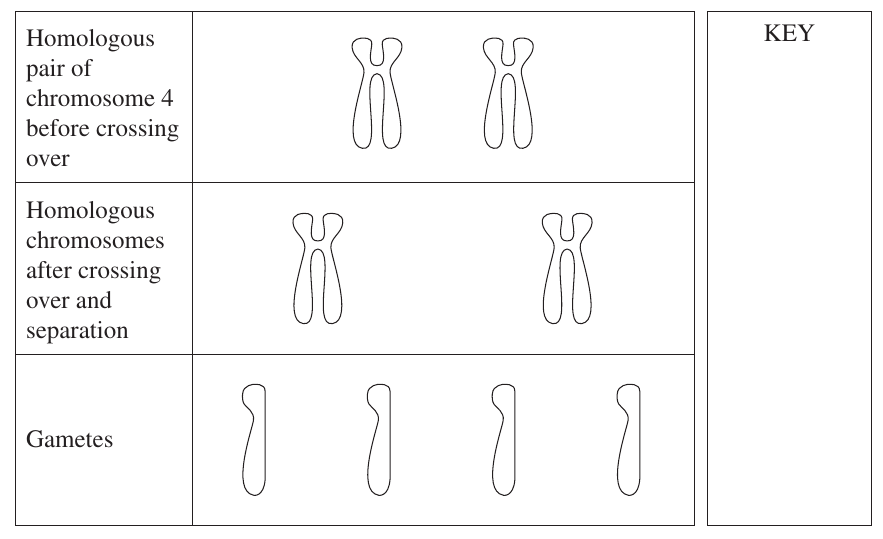
The diagram shows the patient’s homologous pair of chromosome 4 at various stages of meiosis.
Add the relevant alleles to the diagram to model the production of possible gamete combinations. Include a key and an example of crossing over.
Syllabus alignment
- Cell ReplicationModel mitosis, meiosis and DNA replication using nucleotide pairing and bonding.
- Genetic VariationPredict offspring variation by modelling meiosis, crossing over, fertilisation and mutation.