Q18
Question
Shared information
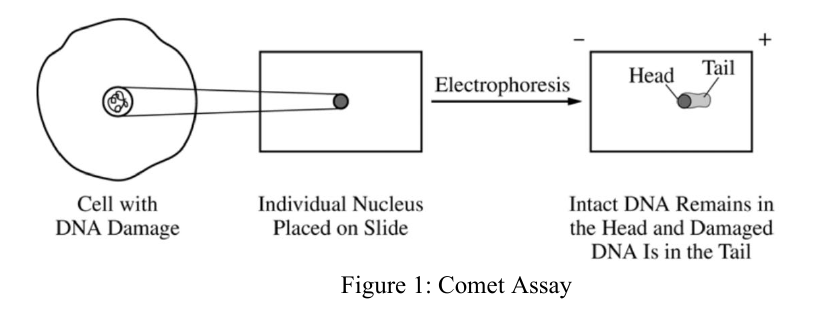
A comet assay is a technique used to determine the amount of double-strand breakages in DNA (DNA damage) in cells. A cell is exposed to a mutagen that damages the DNA causing double-strand breaks. The nucleus of the cell is placed on a microscope slide coated with an agarose gel. An electric current is applied to the gel that causes DNA to move (electrophoresis), and the DNA is stained with a fluorescent dye. When viewed using a microscope, undamaged DNA from the nucleus appears as a round shape (the head), and the fragments of damaged DNA with double strand breaks extend out from the head (the tail). The length of the tail corresponds to the amount of the damage in the DNA. Figure 1: Comet Assay
In a separate experiment, cells are treated with a chemical mutagen that causes only nucleotide substitutions in DNA. Which of the following is the most correct prediction for the result of a comet assay for this treatment?
A. The tail will be longer than a cell with double-stranded breaks in DNA.
B. The head will remain in place and the tail will move towards the negative terminal.
C. The only visible part will be the head with no tail.
D. There will be no visible head or tail.
Syllabus alignment
- MutationCompare causes, processes and effects of point and chromosomal mutations.